

There can’t be anything more damaging for a country than its government which thinks that only traditional policies and practices are t
Despite Ceasefires Across Three Fronts, All Sides Are Preparing for Renewed Combat. By Jonathan Spyer
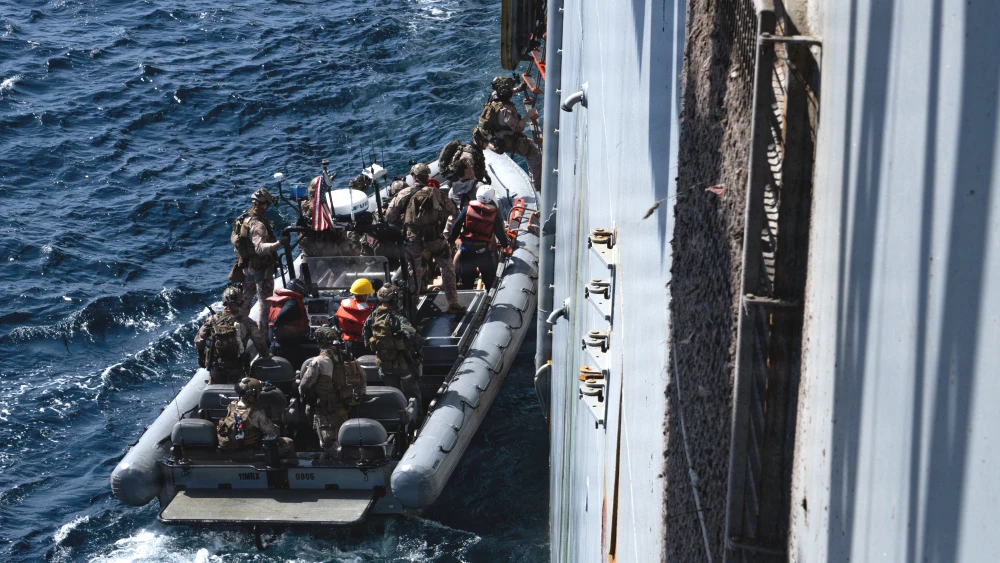
U.S. Marines from the 31st Marine Expeditionary Unit board M/V Blue Star III, a commercial ship suspected of attempting to transit to Iran in violation of the U.S. blockade of Iranian ports, April 28, 2026. U.S. forces released the vessel after conducting a search and confirming the ship’s voyage would not include an Iranian port call. (U.S. Marine Corps photo)
U.S. Marines from the 31st Marine Expeditionary Unit board M/V Blue Star III, a commercial ship suspected of attempting to transit to Iran in violation of the U.S. blockade of Iranian ports, April 28, 2026. U.S. forces released the vessel after conducting a search and confirming the ship’s voyage would not include an Iranian port call. (U.S. Marine Corps photo)U.S. Central Command Public Affairs
The multi front conflict in the Middle East triggered by Hamas’s October 7 attacks is still under way, despite the nominal and very fragile ceasefires in place on the US-Iran, Lebanon and Gaza fronts. In each of these arenas, the sides are attempting to leverage their areas of strength, preparing for further rounds of active conflict ahead. The Islamist, pro-Iran side operates under a clearly formulated ‘forever war’ doctrine, in which it understands itself to be engaged in an open ended Islamic revolutionary struggle, intended to conclude only with the complete defeat and destruction of its enemies. In this struggle, it makes no distinctions between the civil and military realms, or between civilians and combatants. It does not separate education, or worship, or social mobilization from more kinetic and military forms of struggle. It also does not distinguish between periods of active combat and lulls, or times of reduced intensity. All are understood as elements of a single effort, leading in a single direction. The Arabic term ‘muqawama’ – resistance – is often invoked to characterize this outlook. The concept of ‘jihad’ in its broadest definition is also relevant.
The Islamist, pro-Iran side operates under a clearly formulated ‘forever war’ doctrine, in which it understands itself to be engaged in an open ended Islamic revolutionary struggle.
No corresponding, all-encompassing doctrine exists on the Israeli, US or western side. In the English-speaking world, indeed, the oft cited term ‘forever war’ has a frightening and negative connotation. This, in the wake of the long and unsuccessful wars against Muslim enemies in Afghanistan and Iraq, is precisely what western publics don’t want, and what, famously, they vote against. In Israel, nevertheless, there is a growing but still far from fully crystallized realization that when it comes to forever wars, the enemy gets a vote. That is, you may not want to be in a long, open-ended struggle for survival, but if a powerful enemy has committed himself to a project of that kind that’s meant to end in your destruction, you’d be best advised to make yourself aware of that fact, and to plan accordingly. From this point of view, Israel might offer a useful example to western societies. Not because it always gets it right, which it surely doesn’t, but because the nature of what it’s been required to attempt in recent years probably resembles the necessities and imperatives facing the open societies of the west in the period we are now entering.
At the most senior levels, in any case, in both the US and Israel, there appears to have been yet again in the current war a failure to properly take into account the nature of the enemy and the project in which he is engaged. Exaggerated expectations of early victory failed to materialize. A long, grinding battle of wills is now under way, between a US and Israeli side enjoying overwhelming technological superiority and an Iranian/Islamist side with a somewhat clearer strategic doctrine and sense of direction. So what’s the current state of play on the various fronts?
US-Iran
The first round of negotiations between the US and Iran in Islamabad led to inflated hopes of an early resolution. Predictably, these have failed to be realized. The US appears in no hurry to reignite all out conflict. Instead, an attritional struggle is now under way. The US seizure of the Iranian flagged cargo ship Touska in the Gulf of Oman on April 19, and Iran’s subsequent launching of drone strikes on US vessels offer a glimpse of what may well be to come, as each side attempts to impose its will in contested spaces.
The kinetic action on the waterways is accompanied by an ongoing war of words. Much media coverage in recent days focused on the widely differing messages emerging from the US and from Iran, with President Trump’s Truth Social account and the account of Iranian Parliament Speaker and senior negotiator Mohammed Ghalibaf appearing to directly contradict one another on the nature of what has supposedly been agreed. Trump, for example, claimed that Iran had agreed that the US would retrieve the 440kg of enriched uranium held by Iran. Ghalibaf dismissed this.
The prospect is for more brinkmanship, probably more intermittent rounds of negotiations accompanied by partial returns to military action and coercion on the part of both parties.
In practice, both sides are maintaining their efforts to exercise control in Hormuz. Each, evidently, expects the other to blink first. Iran’s latest ‘offer,’ delivered on Monday, according to which the Strait would be opened in return for an end to the war and the lifting of the US blockade was clearly not tabled in any expectation that the US might accept it. Such an outcome would represent a clear victory for Teheran. It would effectively restore the status quo ante bellum, demonstrating that Iranian aggression in seizing the strait had achieved its goal. But Teheran appears to want to drag out the negotiating process and thus de-incentivize a full return to war on the part of the US.
So beyond the ‘ceasefire’ there is currently no common ground on the key issues. The prospect is for more brinkmanship, probably more intermittent rounds of negotiations accompanied by partial returns to military action and coercion on the part of both parties.
Lebanon
Beyond the current noise and spectacle in Israel of dissatisfaction that the war hasn’t solved the problem of Hizballah, the most significant development on the ground is the expanded Israeli buffer zone that has emerged from the conflict of the last two months. Israel has made clear that it will remain in this area to a depth of 10 km along the border line. Hizballah is now beginning an effort to force Israel to abandon this area through a campaign of attrition in which drones are taking center stage.
I took part in a visit by Israeli military correspondents to this area on Monday, april 20. It was the first time that journalists had been permitted to enter the Israeli zone of control across the Lebanese border. We entered the town of Ait a Shaab, once a well known stronghold of the Hizballah organisation. The area is now in rubble, the population departed northwards. The IDF’s strategy appears to be to hold these areas, and keep them unpopulated, so that Hizballah or some new organization cannot make use of the Shia inhabitants to fuel a new insurgency. In this regard, a deliberate differentiation of the population along sectarian lines appears to be under way. Ait a Shaab and Beit Lif, both hitherto Shia, Hizballah-supporting strongholds, have been depopulated and largely demolished. Neighboring Debel, by contrast, a Christian village, is intact and the town’s officials are in contact with Israel regarding essential services.
The present policy in south Lebanon is in keeping with the emergent Israeli practice of creating buffer zones around areas of de facto Islamist control, to make October 7 type rampages impossible and to place anti tank missiles out of range of civilian areas.
Israel intends to avoid recreating the extensive network of manned outposts which it once maintained in southern Lebanon and which proved vulnerable to Hizballah attack in the 1985-2000 period. This time around, the intention will be to make use of largely unmanned, technical systems to locate and neutralize any attempts to enter the buffer zone from the north. These are partial and incomplete solutions. They don’t address the issue of Hizballah drone and missile capabilities, which can of course be launched at Israeli communities from further north, over the buffer zone.
The jury is also still out as to whether Israel will succeed in securing this area along the stated lines. At present, Hizballah’s use of small explosive drones guided by fiber optic cable is proving a challenge for Israeli forces in this area, with both military personnel killed and wounded by Hizballah’s FPV (First Person Vew) drone strikes this week.
But the present policy in south Lebanon is in keeping with the emergent Israeli practice of creating buffer zones around areas of de facto Islamist control, to make October 7 type rampages impossible and to place anti tank missiles out of range of civilian areas. Despite the current focus on the political negotiations between Israel and Lebanon, this is the most significant development. Given that there is no prospect of Israel going north of the Litani to attempt to destroy Hizballah in its entirety, the fact that Trump appears to have imposed the current ceasefire on Israel is of secondary importance. The present contours, more or less, are the inevitable outcome. A future question is whether the US will apply pressure on Israel to withdraw from the buffer zone. At present, this looks unlikely, because a political breakthrough between Israel and the Beirut government does not appear imminent, despite the direct contacts. The government of Lebanon has no coercive power vis a vis Hizballah. Absent the forceful disarming of the movement, the logic of zones of separation looks set to prevail. It will be accompanied by a Hizballah attempt to force an Israeli retreat.
Gaza
This logic applies also in Gaza, the cradle of the current war. There too, in the likely absence of diplomatic progress, the current de facto divisions on the ground are likely to remain. Unlike in Lebanon, however, in Gaza a renewed IDF offensive to destroy the remaining Hamas area of control remains a possibility. On March 21st, the US-led Board of Peace submitted to Hamas their detailed plan for the Strip’s demilitarisation. According to the plan, Hamas would agree to disarm and Israel would then withdraw from most of the 53% of the Gaza Strip it currently holds. Maintaining only a narrow buffer zone along the border. The agreement would end all restrictions on the entry of essential goods, provide for an amnesty for Hamas fighters, and facilitate the entry of trailers for temporary shelter to replace tents.
What this means for the peoples of the region on both sides of the lines is that normality, development and the chance for tranquility and a peaceful life look set to remain only aspirations or elusive dreams in the period ahead.
The proposed agreement envisaged the entry into Gaza of a Palestinian committee of technocrats which would run daily affairs in Gaza as a transitional governing body. An ‘International Stabilisation Force’ would take responsibility for security. The latter body has not yet been established. But in any case, Hamas on April 14th rejected the proposal. The Palestinian Islamist organisation, which still controls 47% of Gaza and the great majority of the Gazan population, accused Israel of not carrying out commitments related to the first phase of the ceasefire agreement.
This Hamas rejection of the US proposed deal threatens the future of the ceasefire. This makes a renewed Israeli offensive possible, but not inevitable. US consent to such an offensive would be needed. The US, however, appears to want to wind down the conflict. Given this preference, the current relative weakness of Hamas, and its failure to join in the recent war, the issue is not currently front and centre in the Israeli discussion.
This does not necessarily mean the status quo will hold indefinitely or even for long. In this regard, it’s worth remembering that the main impediment to Israel’s completing the destruction of the Hamas governing authority during the Gaza war was the presence of Israeli hostages in Hamas captivity. No hostages now remain, which would open up new possibilities should the ceasefire collapse and fighting resume.
The Road Ahead
In all three arenas, one may see the relative strengths and weaknesses of both sides displayed. The Israeli and US advantage is in conventional capacities. The Iranians and their allies cannot face their enemy head on in conventional combat. When battle is engaged along conventional lines, they rapidly come off worst. The advantage that they have is strategic consistency, and patience. The result is that in all three arenas, as a result of the events of the last two and a half years, the Iranian/Islamist side has been physically weakened, but remains in existence and has avoided compromise on any core part of its outlook and project. It can point to disunity and lack of strategic clarity among its enemies as evidence that its long project is, despite setbacks, nevertheless headed in the right direction.
Such a view may be delusional, but if the Iranians and their allies themselves believe it, as they appear to, no major change in the basic shape of the contest appears likely to result from the events of the last months. Rather, the long and exhausting struggle for the future of the Middle East looks set to continue, with periods of lull and sudden flareups into high intensity conflict along the various battlefronts. What this means for the peoples of the region on both sides of the lines is that normality, development and the chance for tranquility and a peaceful life look set to remain only aspirations or elusive dreams in the period ahead.
Published originally on May 1, 2026, under the title “Long, Grinding Battle of Wills over Future of Middle East.”
(Jonathan Spyer oversees the Forum’s content and is editor of the Middle East Quarterly. Mr. Spyer, a journalist, reports for Janes Intelligence Review, writes a column for the Jerusalem Post, and is a contributor to the Wall Street Journal and The Australian. He frequently reports from Syria and Iraq. He has a B.A. from the London School of Economics, an M.A. from the School of Oriental and African Studies in London, and a Ph.D. from the London School of Economics. He is the author of two books: The Transforming Fire: The Rise of the Israel-Islamist Conflict (2010) and Days of the Fall: A Reporter’s Journey in the Syria and Iraq Wars (2017).
U.S. Marines from the 31st Marine Expeditionary Unit board M/V Blue Star III, a commercial ship suspected of attempting to transit to Iran in violation of the U.S. blockade of Iranian ports, April 28, 2026. U.S. forces released the vessel after conducting a search and confirming the ship’s voyage would not include an Iranian port call. (U.S. Marine Corps photo)U.S. Central Command Public Affairs
The multi front conflict in the Middle East triggered by Hamas’s October 7 attacks is still under way, despite the nominal and very fragile ceasefires in place on the US-Iran, Lebanon and Gaza fronts. In each of these arenas, the sides are attempting to leverage their areas of strength, preparing for further rounds of active conflict ahead. The Islamist, pro-Iran side operates under a clearly formulated ‘forever war’ doctrine, in which it understands itself to be engaged in an open ended Islamic revolutionary struggle, intended to conclude only with the complete defeat and destruction of its enemies. In this struggle, it makes no distinctions between the civil and military realms, or between civilians and combatants. It does not separate education, or worship, or social mobilization from more kinetic and military forms of struggle. It also does not distinguish between periods of active combat and lulls, or times of reduced intensity. All are understood as elements of a single effort, leading in a single direction. The Arabic term ‘muqawama’ – resistance – is often invoked to characterize this outlook. The concept of ‘jihad’ in its broadest definition is also relevant.
The Islamist, pro-Iran side operates under a clearly formulated ‘forever war’ doctrine, in which it understands itself to be engaged in an open ended Islamic revolutionary struggle.
No corresponding, all-encompassing doctrine exists on the Israeli, US or western side. In the English-speaking world, indeed, the oft cited term ‘forever war’ has a frightening and negative connotation. This, in the wake of the long and unsuccessful wars against Muslim enemies in Afghanistan and Iraq, is precisely what western publics don’t want, and what, famously, they vote against. In Israel, nevertheless, there is a growing but still far from fully crystallized realization that when it comes to forever wars, the enemy gets a vote. That is, you may not want to be in a long, open-ended struggle for survival, but if a powerful enemy has committed himself to a project of that kind that’s meant to end in your destruction, you’d be best advised to make yourself aware of that fact, and to plan accordingly. From this point of view, Israel might offer a useful example to western societies. Not because it always gets it right, which it surely doesn’t, but because the nature of what it’s been required to attempt in recent years probably resembles the necessities and imperatives facing the open societies of the west in the period we are now entering.
At the most senior levels, in any case, in both the US and Israel, there appears to have been yet again in the current war a failure to properly take into account the nature of the enemy and the project in which he is engaged. Exaggerated expectations of early victory failed to materialize. A long, grinding battle of wills is now under way, between a US and Israeli side enjoying overwhelming technological superiority and an Iranian/Islamist side with a somewhat clearer strategic doctrine and sense of direction. So what’s the current state of play on the various fronts?
US-Iran
The first round of negotiations between the US and Iran in Islamabad led to inflated hopes of an early resolution. Predictably, these have failed to be realized. The US appears in no hurry to reignite all out conflict. Instead, an attritional struggle is now under way. The US seizure of the Iranian flagged cargo ship Touska in the Gulf of Oman on April 19, and Iran’s subsequent launching of drone strikes on US vessels offer a glimpse of what may well be to come, as each side attempts to impose its will in contested spaces.
The kinetic action on the waterways is accompanied by an ongoing war of words. Much media coverage in recent days focused on the widely differing messages emerging from the US and from Iran, with President Trump’s Truth Social account and the account of Iranian Parliament Speaker and senior negotiator Mohammed Ghalibaf appearing to directly contradict one another on the nature of what has supposedly been agreed. Trump, for example, claimed that Iran had agreed that the US would retrieve the 440kg of enriched uranium held by Iran. Ghalibaf dismissed this.
The prospect is for more brinkmanship, probably more intermittent rounds of negotiations accompanied by partial returns to military action and coercion on the part of both parties.
In practice, both sides are maintaining their efforts to exercise control in Hormuz. Each, evidently, expects the other to blink first. Iran’s latest ‘offer,’ delivered on Monday, according to which the Strait would be opened in return for an end to the war and the lifting of the US blockade was clearly not tabled in any expectation that the US might accept it. Such an outcome would represent a clear victory for Teheran. It would effectively restore the status quo ante bellum, demonstrating that Iranian aggression in seizing the strait had achieved its goal. But Teheran appears to want to drag out the negotiating process and thus de-incentivize a full return to war on the part of the US.
So beyond the ‘ceasefire’ there is currently no common ground on the key issues. The prospect is for more brinkmanship, probably more intermittent rounds of negotiations accompanied by partial returns to military action and coercion on the part of both parties.
Lebanon
Beyond the current noise and spectacle in Israel of dissatisfaction that the war hasn’t solved the problem of Hizballah, the most significant development on the ground is the expanded Israeli buffer zone that has emerged from the conflict of the last two months. Israel has made clear that it will remain in this area to a depth of 10 km along the border line. Hizballah is now beginning an effort to force Israel to abandon this area through a campaign of attrition in which drones are taking center stage.
I took part in a visit by Israeli military correspondents to this area on Monday, april 20. It was the first time that journalists had been permitted to enter the Israeli zone of control across the Lebanese border. We entered the town of Ait a Shaab, once a well known stronghold of the Hizballah organisation. The area is now in rubble, the population departed northwards. The IDF’s strategy appears to be to hold these areas, and keep them unpopulated, so that Hizballah or some new organization cannot make use of the Shia inhabitants to fuel a new insurgency. In this regard, a deliberate differentiation of the population along sectarian lines appears to be under way. Ait a Shaab and Beit Lif, both hitherto Shia, Hizballah-supporting strongholds, have been depopulated and largely demolished. Neighboring Debel, by contrast, a Christian village, is intact and the town’s officials are in contact with Israel regarding essential services.
The present policy in south Lebanon is in keeping with the emergent Israeli practice of creating buffer zones around areas of de facto Islamist control, to make October 7 type rampages impossible and to place anti tank missiles out of range of civilian areas.
Israel intends to avoid recreating the extensive network of manned outposts which it once maintained in southern Lebanon and which proved vulnerable to Hizballah attack in the 1985-2000 period. This time around, the intention will be to make use of largely unmanned, technical systems to locate and neutralize any attempts to enter the buffer zone from the north. These are partial and incomplete solutions. They don’t address the issue of Hizballah drone and missile capabilities, which can of course be launched at Israeli communities from further north, over the buffer zone.
The jury is also still out as to whether Israel will succeed in securing this area along the stated lines. At present, Hizballah’s use of small explosive drones guided by fiber optic cable is proving a challenge for Israeli forces in this area, with both military personnel killed and wounded by Hizballah’s FPV (First Person Vew) drone strikes this week.
But the present policy in south Lebanon is in keeping with the emergent Israeli practice of creating buffer zones around areas of de facto Islamist control, to make October 7 type rampages impossible and to place anti tank missiles out of range of civilian areas. Despite the current focus on the political negotiations between Israel and Lebanon, this is the most significant development. Given that there is no prospect of Israel going north of the Litani to attempt to destroy Hizballah in its entirety, the fact that Trump appears to have imposed the current ceasefire on Israel is of secondary importance. The present contours, more or less, are the inevitable outcome. A future question is whether the US will apply pressure on Israel to withdraw from the buffer zone. At present, this looks unlikely, because a political breakthrough between Israel and the Beirut government does not appear imminent, despite the direct contacts. The government of Lebanon has no coercive power vis a vis Hizballah. Absent the forceful disarming of the movement, the logic of zones of separation looks set to prevail. It will be accompanied by a Hizballah attempt to force an Israeli retreat.
Gaza
This logic applies also in Gaza, the cradle of the current war. There too, in the likely absence of diplomatic progress, the current de facto divisions on the ground are likely to remain. Unlike in Lebanon, however, in Gaza a renewed IDF offensive to destroy the remaining Hamas area of control remains a possibility. On March 21st, the US-led Board of Peace submitted to Hamas their detailed plan for the Strip’s demilitarisation. According to the plan, Hamas would agree to disarm and Israel would then withdraw from most of the 53% of the Gaza Strip it currently holds. Maintaining only a narrow buffer zone along the border. The agreement would end all restrictions on the entry of essential goods, provide for an amnesty for Hamas fighters, and facilitate the entry of trailers for temporary shelter to replace tents.
What this means for the peoples of the region on both sides of the lines is that normality, development and the chance for tranquility and a peaceful life look set to remain only aspirations or elusive dreams in the period ahead.
The proposed agreement envisaged the entry into Gaza of a Palestinian committee of technocrats which would run daily affairs in Gaza as a transitional governing body. An ‘International Stabilisation Force’ would take responsibility for security. The latter body has not yet been established. But in any case, Hamas on April 14th rejected the proposal. The Palestinian Islamist organisation, which still controls 47% of Gaza and the great majority of the Gazan population, accused Israel of not carrying out commitments related to the first phase of the ceasefire agreement.
This Hamas rejection of the US proposed deal threatens the future of the ceasefire. This makes a renewed Israeli offensive possible, but not inevitable. US consent to such an offensive would be needed. The US, however, appears to want to wind down the conflict. Given this preference, the current relative weakness of Hamas, and its failure to join in the recent war, the issue is not currently front and centre in the Israeli discussion.
This does not necessarily mean the status quo will hold indefinitely or even for long. In this regard, it’s worth remembering that the main impediment to Israel’s completing the destruction of the Hamas governing authority during the Gaza war was the presence of Israeli hostages in Hamas captivity. No hostages now remain, which would open up new possibilities should the ceasefire collapse and fighting resume.
The Road Ahead
In all three arenas, one may see the relative strengths and weaknesses of both sides displayed. The Israeli and US advantage is in conventional capacities. The Iranians and their allies cannot face their enemy head on in conventional combat. When battle is engaged along conventional lines, they rapidly come off worst. The advantage that they have is strategic consistency, and patience. The result is that in all three arenas, as a result of the events of the last two and a half years, the Iranian/Islamist side has been physically weakened, but remains in existence and has avoided compromise on any core part of its outlook and project. It can point to disunity and lack of strategic clarity among its enemies as evidence that its long project is, despite setbacks, nevertheless headed in the right direction.
Such a view may be delusional, but if the Iranians and their allies themselves believe it, as they appear to, no major change in the basic shape of the contest appears likely to result from the events of the last months. Rather, the long and exhausting struggle for the future of the Middle East looks set to continue, with periods of lull and sudden flareups into high intensity conflict along the various battlefronts. What this means for the peoples of the region on both sides of the lines is that normality, development and the chance for tranquility and a peaceful life look set to remain only aspirations or elusive dreams in the period ahead.
Published originally on May 1, 2026, under the title “Long, Grinding Battle of Wills over Future of Middle East.”
(Jonathan Spyer oversees the Forum’s content and is editor of the Middle East Quarterly. Mr. Spyer, a journalist, reports for Janes Intelligence Review, writes a column for the Jerusalem Post, and is a contributor to the Wall Street Journal and The Australian. He frequently reports from Syria and Iraq. He has a B.A. from the London School of Economics, an M.A. from the School of Oriental and African Studies in London, and a Ph.D. from the London School of Economics. He is the author of two books: The Transforming Fire: The Rise of the Israel-Islamist Conflict (2010) and Days of the Fall: A Reporter’s Journey in the Syria and Iraq Wars (2017).
You May Also Like

In Pakistan’s turbulent political landscape, Parliament remains the one institution where disagreement can be converted into dialogue and con

Some of the people diagnosed with TB in a couple of important community-based screening initiatives in Delhi did not come to the health facility co


PCP need your support that we may provide you better services: click on donate


"Trial of Pakistani Christian Nation" By Nazir S Bhatti
On demand of our readers, I have decided to release E-Book version of "Trial of Pakistani Christian Nation" on website of PCP which can also be viewed on website of Pakistan Christian Congress www.pakistanchristiancongress.org . You can read chapter wise by clicking tab on left handside of PDF format of E-Book.