

There can’t be anything more damaging for a country than its government which thinks that only traditional policies and practices are t
Ink Against Oblivion: How Vellichor Turns Literature into Cinematic Suspense. By Khalid Hassan Khan
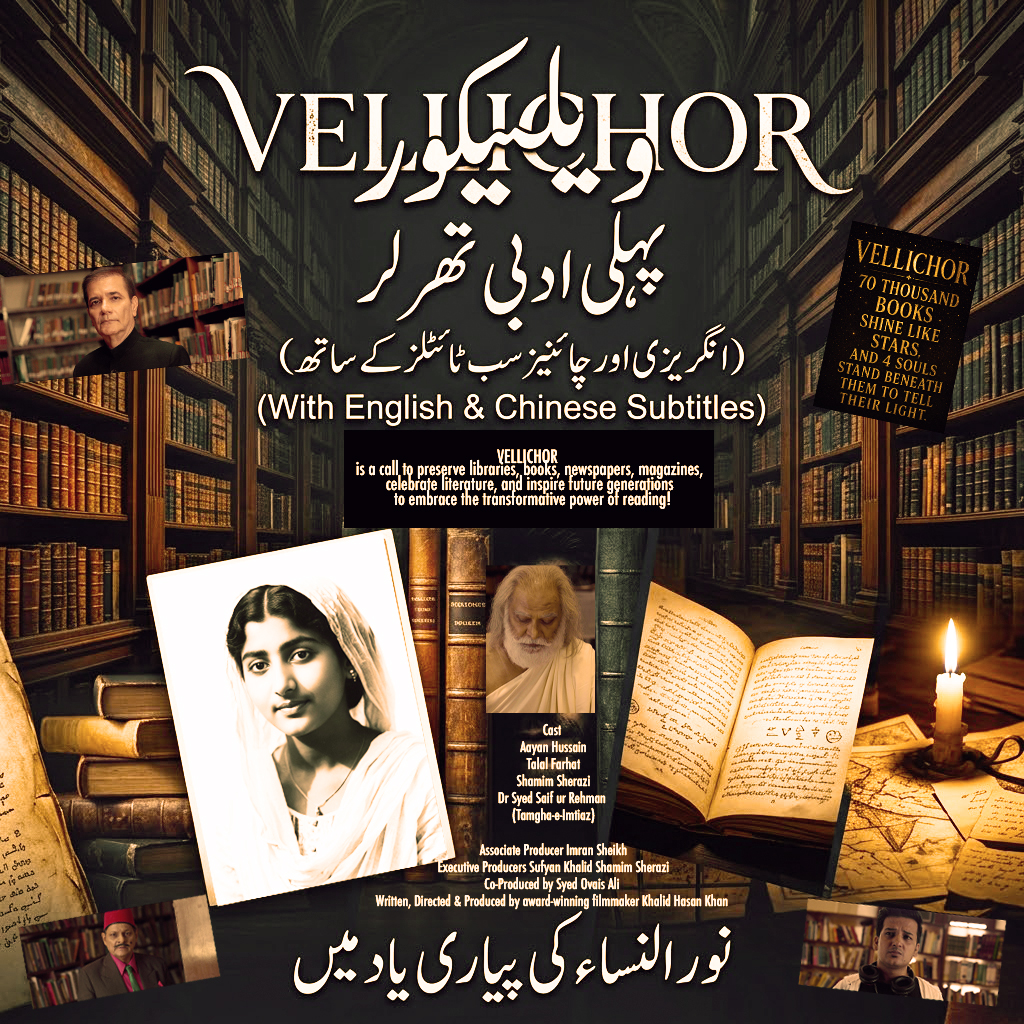
In an era where glowing screens dominate our attention and digital ephemera increasingly replace the permanence of paper, a Pakistani film dares to reclaim the sanctity of the printed word. Vellichor, a 40-minute original literary thriller, arrives as both cinematic meditation and cultural statement, compelling work that transforms nostalgia for books into suspense, philosophy, and visual poetry.
Set within the historic grandeur of Karachi’s iconic Frere Hall Library, home to nearly seventy thousand books, the film is more than a thriller. It is a tribute to print culture, handwritten letters, newspapers, and the fading tactile world of ink on paper.
The title itself carries poetic resonance. “Vellichor” refers to the wistful nostalgia one experiences while wandering through old libraries and second-hand bookshops, the scent of yellowing pages, the silence of knowledge waiting to be rediscovered, the intimate melancholy of stories that have survived generations. It is precisely this sensation that Khan captures and transforms into cinema.
The film’s cast includes Aayan Hussain, MeMe Hussain, Shamim Sherazi, Dr. Syed Saif ur Rehman, and Talal Farhat. Each performer contributes to the film’s emotional and symbolic landscape in a distinct way. Dr. Syed Saif ur Rehman appears as Hadi — a dignified librarian whose relationship with books becomes the intellectual and emotional center of the narrative, embodying stewardship, memory, and continuity. Shamim Sherazi portrays Warqah, the Spirit of Paper, a mysterious and symbolic presence representing the endurance of the written word and the resilience of human memory. Alongside them, Aayan Hussain, MeMe Hussain, and Talal Farhat expand the film’s visual and philosophical world, bringing additional dimensions to its exploration of knowledge, time, and human connection with the written page.
At the heart of the film is Dr Syed Saif ur Rehman, a seasoned Pakistani civil servant and recipient of the prestigious Tamgha-e-Imtiaz, who steps into the lead role of Hadi, a dignified librarian whose relationship with books becomes the emotional and philosophical anchor of the narrative.
Casting Dr. Saif ur Rehman in the role is itself a compelling artistic decision. His decades of public service lend gravitas to Hadi, imbuing the character with quiet authority and intellectual depth. As the custodian of the library’s treasured archives, Hadi becomes both guardian and witness to unfolding mysteries that question memory, mortality, and the survival of knowledge itself.
Adding further dimension to the film’s conceptual ambition is Shamim Sherazi, who performs the enigmatic character of Warqa, the spirit of paper, appearing in a striking Roman toga-clad form. Warqa is no ordinary character. He is the embodiment of paper’s enduring soul, a spectral yet commanding figure who personifies the resilience of the written word against the erasure of time.
His presence elevates Vellichor into allegorical terrain, where paper is no longer an object but a living memory. Through Warqa, the film explores a profound philosophical question: what becomes of human civilization when its stories lose physical form?
The choice of setting is central to the film’s impact. The majestic colonial architecture of Frere Hall Library is not simply a backdrop; it breathes as a character in its own right. Towering shelves, long corridors of shadow and light, and thousands of silent books create a space charged with both reverence and tension.
The visual symbolism is unmistakable: seventy thousand books shine like stars, illuminating truths that modernity threatens to eclipse.
Yet what makes Vellichor especially significant is its cultural rootedness. Pakistani cinema has often excelled in social drama and commercial storytelling, but literary thrillers remain rare territory. Khan ventures boldly into this intellectual space, crafting a work that challenges viewers to think deeply about preservation, legacy, and the fragile permanence of recorded thought.
The film also carries an emotional dedication to Begum Noor un Nissa, a fictitious character, in whose memory the library was established to promote education, particularly among women and children. This dedication gives the project a deeply human foundation, connecting the story to a broader mission of enlightenment and empowerment.
In many ways, Vellichor is a quiet act of resistance against forgetfulness.
As societies hurtle toward total digitisation, the film reminds us that paper possesses a permanence digital formats often cannot guarantee. A handwritten margin note, a folded letter, a newspaper clipping browned with age, these are not merely objects, but witnesses to lived history.
Written, directed, and produced by Khalid Hasan Khan, a graduate of the New York Film Academy whose films have been screened at over one hundred film festivals across all continents and who has won twenty-six international awards, Vellichor reflects the vision of a filmmaker deeply invested in stories that transcend entertainment to become acts of cultural preservation.The project is co-produced by Syed Ovais Ali, whose collaboration strengthens a production that seeks not merely to entertain but to advocate for intellectual heritage and literary consciousness.
Khan’s directorial restraint appears to embrace atmosphere over excess. Suspense emerges through silence, shadow, and contemplation rather than spectacle. This measured aesthetic allows the philosophical core of the story to breathe, drawing audiences into a reflective encounter with the physicality of knowledge.
For Pakistan, a nation with profound literary and intellectual traditions, Vellichor serves as an important reminder of what libraries represent: not relics of the past, but living sanctuaries of thought.
At just forty minutes, the film promises a remarkable density of meaning. It is concise yet expansive, intimate yet universal.
If contemporary cinema often reflects fleeting trends, Vellichor aspires to something more enduring. It whispers a truth every old book already knows ,screens may flicker and fade, but ink remembers.
Set within the historic grandeur of Karachi’s iconic Frere Hall Library, home to nearly seventy thousand books, the film is more than a thriller. It is a tribute to print culture, handwritten letters, newspapers, and the fading tactile world of ink on paper.
The title itself carries poetic resonance. “Vellichor” refers to the wistful nostalgia one experiences while wandering through old libraries and second-hand bookshops, the scent of yellowing pages, the silence of knowledge waiting to be rediscovered, the intimate melancholy of stories that have survived generations. It is precisely this sensation that Khan captures and transforms into cinema.
The film’s cast includes Aayan Hussain, MeMe Hussain, Shamim Sherazi, Dr. Syed Saif ur Rehman, and Talal Farhat. Each performer contributes to the film’s emotional and symbolic landscape in a distinct way. Dr. Syed Saif ur Rehman appears as Hadi — a dignified librarian whose relationship with books becomes the intellectual and emotional center of the narrative, embodying stewardship, memory, and continuity. Shamim Sherazi portrays Warqah, the Spirit of Paper, a mysterious and symbolic presence representing the endurance of the written word and the resilience of human memory. Alongside them, Aayan Hussain, MeMe Hussain, and Talal Farhat expand the film’s visual and philosophical world, bringing additional dimensions to its exploration of knowledge, time, and human connection with the written page.
At the heart of the film is Dr Syed Saif ur Rehman, a seasoned Pakistani civil servant and recipient of the prestigious Tamgha-e-Imtiaz, who steps into the lead role of Hadi, a dignified librarian whose relationship with books becomes the emotional and philosophical anchor of the narrative.
Casting Dr. Saif ur Rehman in the role is itself a compelling artistic decision. His decades of public service lend gravitas to Hadi, imbuing the character with quiet authority and intellectual depth. As the custodian of the library’s treasured archives, Hadi becomes both guardian and witness to unfolding mysteries that question memory, mortality, and the survival of knowledge itself.
Adding further dimension to the film’s conceptual ambition is Shamim Sherazi, who performs the enigmatic character of Warqa, the spirit of paper, appearing in a striking Roman toga-clad form. Warqa is no ordinary character. He is the embodiment of paper’s enduring soul, a spectral yet commanding figure who personifies the resilience of the written word against the erasure of time.
His presence elevates Vellichor into allegorical terrain, where paper is no longer an object but a living memory. Through Warqa, the film explores a profound philosophical question: what becomes of human civilization when its stories lose physical form?
The choice of setting is central to the film’s impact. The majestic colonial architecture of Frere Hall Library is not simply a backdrop; it breathes as a character in its own right. Towering shelves, long corridors of shadow and light, and thousands of silent books create a space charged with both reverence and tension.
The visual symbolism is unmistakable: seventy thousand books shine like stars, illuminating truths that modernity threatens to eclipse.
Yet what makes Vellichor especially significant is its cultural rootedness. Pakistani cinema has often excelled in social drama and commercial storytelling, but literary thrillers remain rare territory. Khan ventures boldly into this intellectual space, crafting a work that challenges viewers to think deeply about preservation, legacy, and the fragile permanence of recorded thought.
The film also carries an emotional dedication to Begum Noor un Nissa, a fictitious character, in whose memory the library was established to promote education, particularly among women and children. This dedication gives the project a deeply human foundation, connecting the story to a broader mission of enlightenment and empowerment.
In many ways, Vellichor is a quiet act of resistance against forgetfulness.
As societies hurtle toward total digitisation, the film reminds us that paper possesses a permanence digital formats often cannot guarantee. A handwritten margin note, a folded letter, a newspaper clipping browned with age, these are not merely objects, but witnesses to lived history.
Written, directed, and produced by Khalid Hasan Khan, a graduate of the New York Film Academy whose films have been screened at over one hundred film festivals across all continents and who has won twenty-six international awards, Vellichor reflects the vision of a filmmaker deeply invested in stories that transcend entertainment to become acts of cultural preservation.The project is co-produced by Syed Ovais Ali, whose collaboration strengthens a production that seeks not merely to entertain but to advocate for intellectual heritage and literary consciousness.
Khan’s directorial restraint appears to embrace atmosphere over excess. Suspense emerges through silence, shadow, and contemplation rather than spectacle. This measured aesthetic allows the philosophical core of the story to breathe, drawing audiences into a reflective encounter with the physicality of knowledge.
For Pakistan, a nation with profound literary and intellectual traditions, Vellichor serves as an important reminder of what libraries represent: not relics of the past, but living sanctuaries of thought.
At just forty minutes, the film promises a remarkable density of meaning. It is concise yet expansive, intimate yet universal.
If contemporary cinema often reflects fleeting trends, Vellichor aspires to something more enduring. It whispers a truth every old book already knows ,screens may flicker and fade, but ink remembers.
You May Also Like

In Pakistan’s turbulent political landscape, Parliament remains the one institution where disagreement can be converted into dialogue and con

Some of the people diagnosed with TB in a couple of important community-based screening initiatives in Delhi did not come to the health facility co


PCP need your support that we may provide you better services: click on donate


"Trial of Pakistani Christian Nation" By Nazir S Bhatti
On demand of our readers, I have decided to release E-Book version of "Trial of Pakistani Christian Nation" on website of PCP which can also be viewed on website of Pakistan Christian Congress www.pakistanchristiancongress.org . You can read chapter wise by clicking tab on left handside of PDF format of E-Book.